Amazon RDS vs Heroku Postgres: Which Should You Pick?
Amazon RDS vs Heroku Postgres: which wins depends on your AWS setup, Heroku's Feb 2026 status, and whether you need Asia or Middle East data residency.
Amazon RDS fits a team already standardized on AWS that wants deep control and can manage a metered bill. Heroku Postgres fits a team that wants zero-ops simplicity and stays in the US or Europe. If your users or your data residency requirement sit in Asia or the Middle East, neither one gives you a flat, predictable bill built around that.
Choose Amazon RDS if you live inside AWS’s IAM and VPC model and can watch a metered bill.
Choose Heroku Postgres if simplicity matters more than cost and your users sit in the US or Europe.
Choose Nearbase if you want one flat price in every region, including Asia and the Middle East.
TL;DR
RDS gives you a hyperscaler’s control and a bill that only a cost-conscious team can keep under control. Heroku Postgres trades that control for a database you barely have to think about, as long as your users are in the US or Europe. Neither is the answer if your production database needs to sit near users in Jakarta, Dubai, or Singapore at a price you can actually predict.
Amazon RDS vs Heroku Postgres at a glance
| Dimension | Amazon RDS for PostgreSQL | Heroku Postgres |
|---|---|---|
| Pricing model | Metered: instance-hours, storage, IOPS, backups, and data transfer billed separately | Flat tiers, but the affordable ones ($5 to $20/mo) only run in Heroku’s shared US/EU runtime |
| Entry point | A free-tier allowance for new AWS accounts, then metered | $5/mo for the smallest Essential-0 plan, no free tier |
| Asia/ME regions | Wide hub-city coverage, including Singapore, Tokyo, Mumbai, Jakarta, and the UAE | Only inside a Private Space, which starts at the $300/mo Private tier |
| Managed scope | Automated backups, patching, and Multi-AZ failover, configurable per instance | Automated backups, forking, and follower databases; failover on Premium tier and above |
| Postgres compatibility | Standard PostgreSQL, current major versions | Standard PostgreSQL, with Heroku-specific extensions for fork and follow |
| Ops burden | Low, but someone still has to size instances, storage, and IOPS | Very low; Heroku hides most of the underlying infrastructure |
| Where it falls short | Storage, I/O, and Multi-AZ charges increase gradually, and cost-sensitive teams often don’t notice until the bill is much higher | The affordable tiers never leave US/EU; an Asia region forces a $300/mo-plus jump |
What is Amazon RDS?
Amazon RDS is Amazon Web Services’ managed database service for relational engines, and PostgreSQL is one of several it runs alongside MySQL, MariaDB, SQL Server, and Oracle. RDS is the hosting and orchestration layer, not the database engine itself: standard, unmodified open-source PostgreSQL runs underneath it. AWS manages the operating system, patching, and physical infrastructure, so a team gets a PostgreSQL endpoint to connect to rather than a server it has to maintain by hand.
What is Heroku Postgres?
Heroku Postgres is Heroku’s own managed PostgreSQL service, attached to an app as a first-party add-on rather than a database a team provisions and connects to separately. Salesforce, which owns Heroku, operates the underlying infrastructure, so provisioning, patching, and connection handling happen without anyone touching a server directly. It runs the same standard, open-source PostgreSQL engine RDS runs, just packaged inside Heroku’s own platform instead of AWS’s.
Amazon RDS: the verdict
Who it’s for: Amazon RDS
Amazon RDS for PostgreSQL is AWS’s fully managed relational database service. It runs standard PostgreSQL and handles provisioning, patching, backups, and failover for you. It fits a team that already lives inside AWS’s networking, IAM, and VPC model, because everything about it plugs into tools that team already uses. RDS runs across AWS’s regional footprint, including deep Asia Pacific coverage (Singapore, Tokyo, Osaka, Seoul, Mumbai, Jakarta, Hong Kong) and Middle East regions in Bahrain and the UAE. Coverage is strongest in the hub cities.
What it does well: Amazon RDS
- Automated provisioning, patching, and backups across every supported PostgreSQL version
- Multi-AZ deployments with a standby replica and automatic failover, configurable per instance
- Point-in-time recovery and manual or automated snapshots
- Provisioned IOPS storage for I/O-heavy workloads, on top of general-purpose SSD
- Deep integration with AWS IAM, VPC, and CloudWatch, a layer of platform lock-in Heroku does not ask for or expose
Where it falls short: Amazon RDS
The metered bill is the real risk: storage, I/O, and Multi-AZ charges add up without an obvious warning. One concrete example, a Single-AZ provisioned-IOPS volume:
- Single-AZ: around $428 a month
- Same volume with Multi-AZ added: roughly $856 a month, about double
Reviewers repeatedly report the same bill escalating unexpectedly once storage, I/O, Multi-AZ, and backups stack up. On top of that, you get no OS or superuser access to the underlying instance. We would not put a cost-sensitive team on RDS. We would also steer anyone needing superuser access, or hosting for users in Asia, toward a cheaper regional provider that undercuts RDS on price. Nearbase’s own comparison against RDS covers the cost and latency picture in Asia in more depth.
Resources and support: Amazon RDS
Every AWS account gets free Basic Support: documentation, AWS re:Post, and Trusted Advisor’s core checks. Three paid tiers add faster response times and a named technical contact:
- Business Support+: from $29/mo
- Enterprise Support: from $5,000/mo
- Unified Operations: from $50,000/mo
Documentation runs deep across every AWS service RDS touches, including IAM, VPC, KMS, and CloudWatch.
Best use cases: Amazon RDS
- Teams already running other workloads on AWS who want production Postgres governed under the same IAM, VPC, and CloudWatch model, instead of adding Heroku as a second platform to manage
- Compliance-driven setups that need AWS’s IAM and KMS-level access control and audit depth
- High-availability production databases that justify Multi-AZ failover and provisioned IOPS despite the added cost
Pricing: Amazon RDS
We priced RDS against its own pricing page: instance-hours, storage, IOPS, backups, and data transfer are billed separately, hard to forecast until you have real traffic. The sticker is just the instance-hour rate. The real bill is storage, IOPS, backups, and data transfer stacking on top of that rate. Forecast the total cost of ownership, not the on-demand price. New AWS accounts get a one-year free-tier allowance covering a small Single-AZ instance and 20 GB of storage.
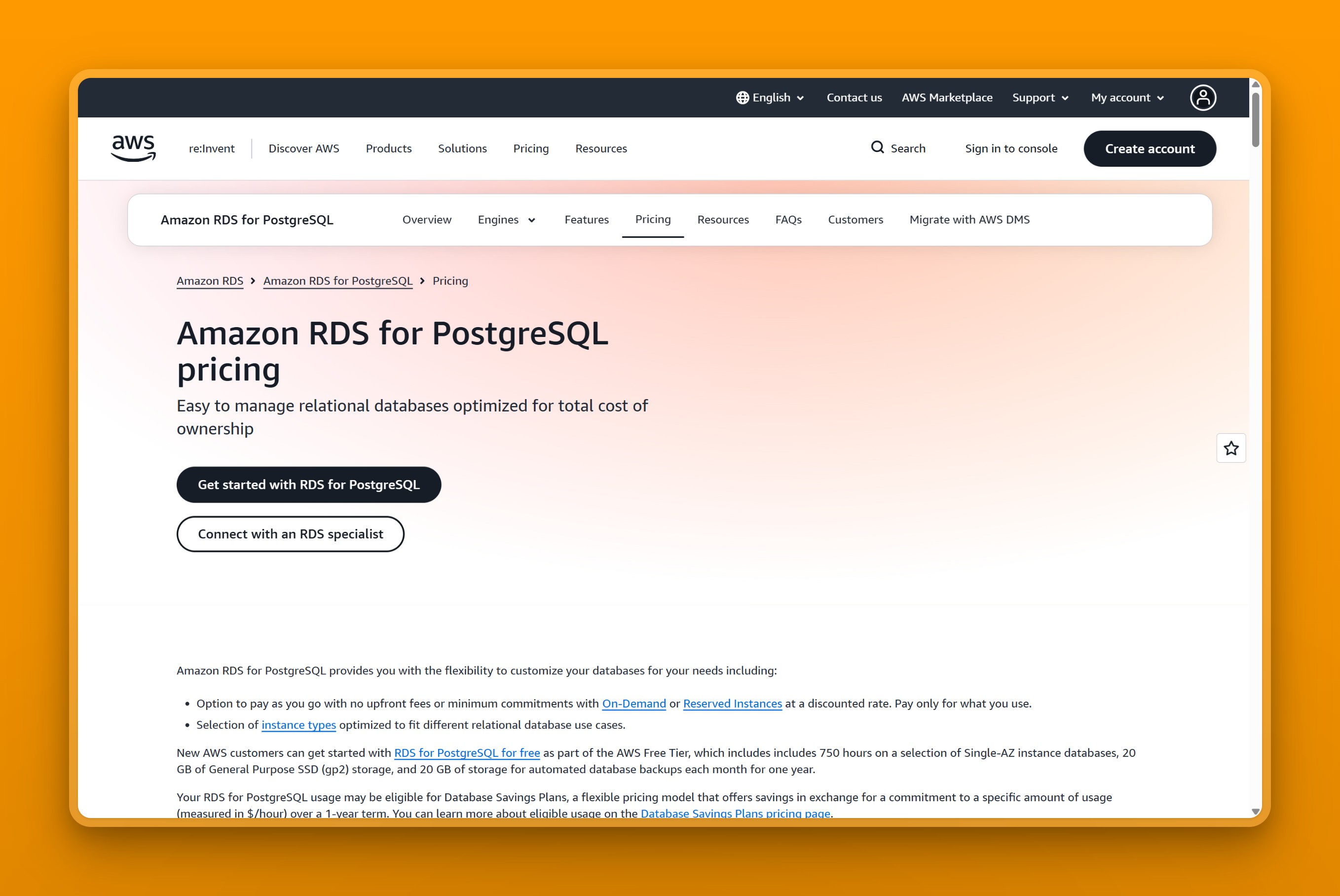 Amazon RDS for PostgreSQL pricing page.
Heroku Postgres: the verdict
Heroku recently announced a shift to a sustaining-engineering model, focused on stability and support rather than new features, a change worth weighing before picking Heroku fresh today. See “Does anyone still use Heroku?” below for what that shift actually means in practice.
Who it’s for: Heroku Postgres
Heroku Postgres is Heroku’s first-party managed PostgreSQL add-on, not a third-party plugin. It runs standard PostgreSQL with a few Heroku-specific conveniences layered on, most notably forking a full copy of a database and following it as a live replica. It fits a team that wants zero-ops simplicity and is comfortable staying in the US or Europe. Every paid tier runs in Heroku’s two Common Runtime regions, us and eu. Heroku Postgres also supports all ten Private Spaces regions, including Tokyo, Singapore, Mumbai, and Sydney, but only when the app runs inside a Private Space, which requires the Private tier.
What it does well: Heroku Postgres
- Fully managed provisioning with no server to patch yourself
- Database forking, so you can spin up an exact copy for testing or a migration
- Follower databases for read replicas and low-downtime cutovers, a lighter-weight setup than RDS’s read replicas, which you provision and manage yourself
- High availability and automatic failover on Premium tier and above
- Rollback windows that extend from four days on Standard to seven days on Premium
Where it falls short: Heroku Postgres
Heroku Postgres is a poor fit for cost-sensitive Asia deployments, because its affordable tiers never leave the US and EU. The moment you need a Tokyo, Singapore, or Mumbai region, you are forced into Private Spaces. Tier jumps are steep on their own too:
- Essential to Standard-0: jumps to $50/mo
- Standard-0 to Premium: doubles again to $200/mo
- A real production stack, once connections and storage add up: routinely $500 to $1,000/mo
We would not pick Heroku Postgres for a team that needs an affordable database in an Asia region, or for a high-connection app about to hit those tier jumps fast.
Resources and support: Heroku Postgres
Every Heroku customer gets Dev Center documentation, the Trailblazer community, and a ticket-based help portal, with best-effort response times. We checked Heroku’s support tiers directly: a dedicated Technical Account Manager sits behind Signature Success only. Premier adds faster response windows plus Customer Solution Architect access; both plans require a Heroku Enterprise Account. Heroku no longer writes new Enterprise Account contracts under its sustaining-engineering shift. That means the tier is effectively closed to new signups, though existing Enterprise customers keep it.
Best use cases: Heroku Postgres
- App-platform simplicity: the database ships as a first-party Heroku add-on, not a separate service to configure
- Existing Heroku shops already deploying on Heroku dynos in the US or EU, using the forking and follower workflow
- Small teams without a dedicated ops person who want zero-server patching and automatic backups out of the box
- Startups prioritizing fast setup over infrastructure control, comfortable with Heroku’s slower feature cadence under sustaining engineering
Pricing: Heroku Postgres
We priced Heroku Postgres against its own pricing page: flat monthly tiers, but the affordable ones are US/EU only. Here is the breakdown:
| Tier | Price | Storage |
|---|---|---|
| Essential-0 | $5/mo | 1 GB |
| Essential-1 | $9/mo | 10 GB |
| Essential-2 | $20/mo | 32 GB |
| Standard (starting) | $50/mo | n/a |
| Private Spaces (starting) | $300/mo | n/a |
The jump to a region outside Common Runtime requires Private Spaces. That $300/mo Private Spaces floor, not the $5/mo sticker, is the real starting price to budget against for any team outside the US or EU. There is no free tier on any current plan.
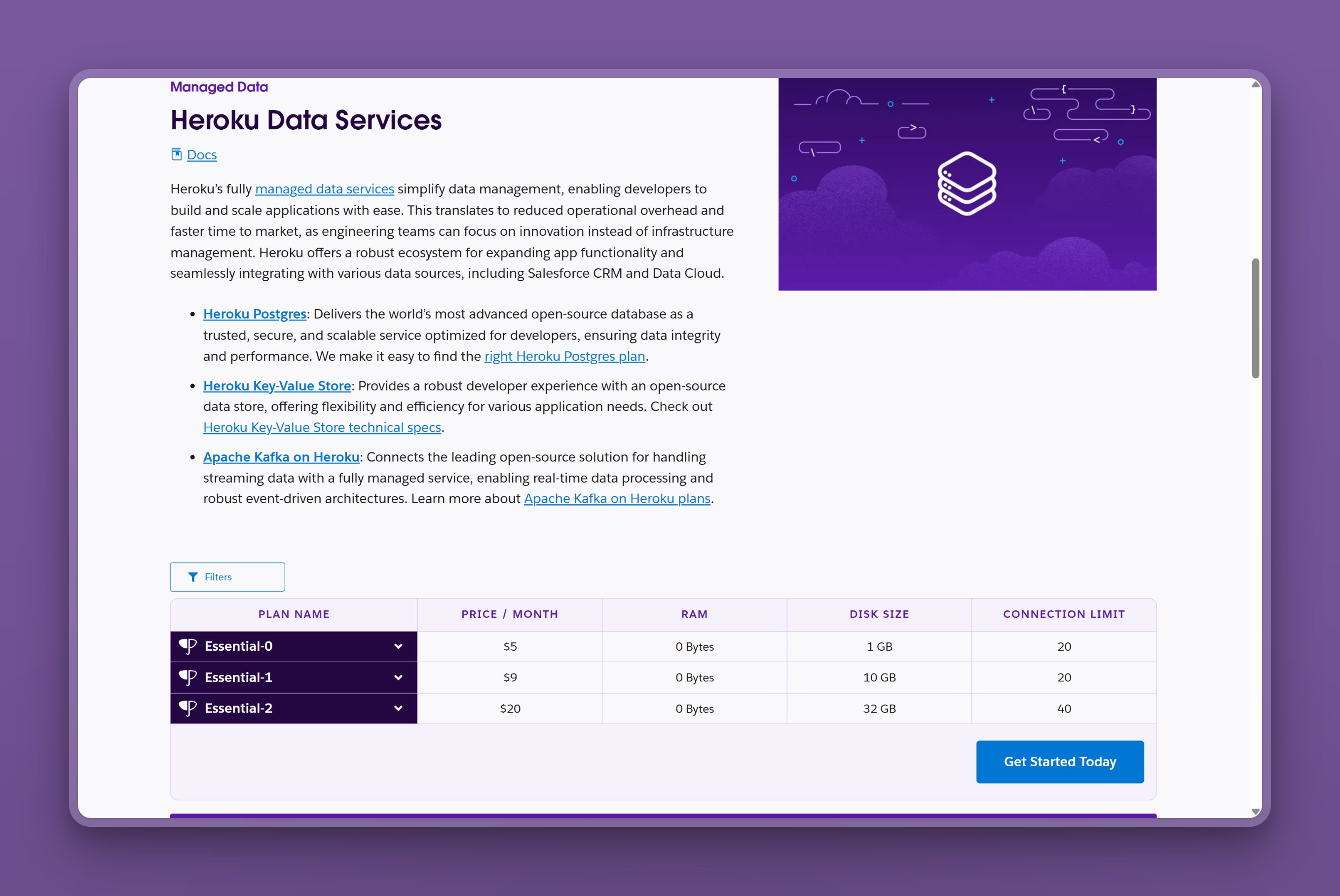 Heroku Postgres Essential plan pricing.
What G2 reviewers say
We checked both listings directly on G2: Amazon RDS scores well for reliability and automation, echoing the same escalating-bill and no-superuser-access complaints already quoted above. Heroku Postgres scores higher, but on a far smaller review sample, too small for the gap to mean much.
| Platform | Product | Rating | Reviews | Source |
|---|---|---|---|---|
| G2 | Amazon RDS | 4.5/5 | 908 | G2 reviews |
| G2 | Heroku Postgres | 4.8/5 | 11 | G2 reviews |
Ratings as of our last check.
How to actually move between Amazon RDS and Heroku Postgres
Both providers run standard PostgreSQL, so migration is a data problem, not a rewrite, in either direction.
Moving from Amazon RDS to Heroku Postgres
Heroku’s own migration guide recommends a dump and restore for databases under 100 GB:
- Run
pg_dump -Fcagainst the RDS instance. - Upload the dump to a private S3 bucket and generate a short-lived presigned URL.
- Run
heroku pg:backups:restoreagainst that URL into a freshly provisioned Heroku Postgres add-on.
Two gotchas worth planning for:
- The restore reassigns every table to Heroku’s own credential, so custom RDS roles do not carry over.
- Every extension your schema depends on has to already be on Heroku’s supported list.
Moving from Heroku Postgres to Amazon RDS
Porter’s migration writeup lays out three real paths:
- Dump and restore. Works cleanly under about 10 GB, as long as extension versions match on both sides.
- WAL-based rebuild on EC2. Gives you an exact replay of Heroku’s write-ahead log, but Heroku’s data team issues the S3 credentials and they expire, so someone has to keep renewing them during the migration.
- Bucardo logical replication. The most reliable option for near-zero downtime, syncing continuously until you cut over. Every table needs a primary key, and a schema change mid-sync will pause the pipeline.
Whichever direction you are going, rehearse against the specific failure points above (roles that did not carry over, credentials that expired mid-transfer) before you repoint production traffic.
Does anyone still use Heroku?
Yes, and we read Heroku’s own update on the shift directly for the clearest answer. Existing customers keep running as normal, and new customers paying by credit card can still sign up with no change to pricing or service. What changed is the company’s own commitment to the platform. Heroku announced it is shifting to a sustaining-engineering model, focused on stability, security, reliability, and support rather than new features. It will no longer offer new Enterprise Account contracts, though existing ones are honored. Salesforce, which owns Heroku, is redirecting investment toward its own enterprise AI priorities instead.
For Heroku Postgres specifically, that means the database itself keeps running exactly as documented here, but the platform around it has stopped moving forward. If simplicity is why you picked Heroku, that calculation has not changed. If you are choosing fresh today and expect years of new capability, weigh that against a provider still actively shipping.
When the real problem is the bill, not the feature list
If your real problem is the bill, not the feature set, a flat, low, predictable price is often worth more than either provider’s flexibility. Put RDS’s region list next to Heroku’s Private Spaces upgrade path, and that gap is a real, priced-in cost, not a hypothetical. That is the gap Nearbase is built to close. It is managed PostgreSQL with one flat monthly price in every region, the same in Jakarta as in Dubai, starting at $6 a month for an entry instance. Storage bills separately at a flat rate too, with no IOPS or per-query meters to watch.
One Reddit user in r/PostgreSQL, weighing the same self-host-versus-managed tradeoff, wrote in a comment: “Self-hosting is fine when you actually want to own that work. I didn’t, so I moved to Nearbase. Backups and maintenance are handled, and the monthly cost is predictable. For me, that was better than learning database ops after the app was already live.”
The regional angle matters here too. Heroku Postgres’s affordable tiers stop at the US and EU, and RDS asks you to compare region by region. Nearbase runs in local data centers across nine Asia and Middle East cities, plus Virginia. A database close to users in Manila, Bangkok, or Dubai does not need an enterprise-tier upgrade the way it does on Heroku.
Nearbase handles provisioning, backups, and routine maintenance for you. Every instance carries a 99.99% uptime SLA. It also helps meet in-country data-residency requirements across Asia and the Middle East, an angle neither RDS’s region list nor Heroku’s Private Spaces upgrade path was designed around.
This is not a fit for every reader here. A team fully wired into AWS’s IAM and VPC model has good reasons to stay put. The same goes for one that needs Heroku’s forking and follower workflow, or one whose users sit outside Nearbase’s ten regions. But if the real requirement is a flat bill and a database that sits near Asia or Middle East users, it is worth weighing before committing further to either incumbent.
A roundup of managed Postgres hosting options covers the wider field beyond just these two, and the data residency explainer walks through what in-country hosting actually requires across the region.
Want a Postgres instance in the same city as your users, at one flat price? Start with Nearbase and provision an instance in your region.
Frequently asked questions
Are PostgreSQL and Amazon RDS the same thing?
No. PostgreSQL is the open-source database engine; Amazon RDS is AWS’s managed hosting layer that runs PostgreSQL (along with several other database engines) and handles provisioning, patching, and backups around it. Heroku Postgres is the same relationship on a different platform: Heroku’s managed layer running standard PostgreSQL underneath.
Does Heroku support PostgreSQL?
Yes. Heroku Postgres is Heroku’s own first-party managed Postgres add-on, not a third-party plugin, and it runs standard PostgreSQL with Heroku-specific extras like database forking and follower replicas layered on top.
Which is cheaper, Amazon RDS or Heroku Postgres?
Heroku is usually cheaper in the US or EU. Amazon RDS is usually cheaper in Asia or the Middle East, since Heroku forces a $300/mo-plus Private Space there. For a US or EU deployment, Heroku’s flat Essential tiers ($5 to $20/mo) can undercut a comparable RDS instance once you add RDS’s storage, IOPS, and backup charges. For an Asia or Middle East deployment, the comparison flips hard, and RDS’s metered regional pricing is usually the cheaper path of the two incumbents. Neither gives you a flat, predictable bill the way Nearbase does.
Can Heroku Postgres run in Asia without upgrading to Private Spaces?
No. Every paid Heroku Postgres tier runs in the us or eu Common Runtime region by default. Reaching Tokyo, Singapore, Mumbai, or any other Private Spaces region requires the Private tier, which starts around $300/mo regardless of how small the database itself is.
Can I migrate from Heroku Postgres to Amazon RDS without much downtime?
Yes, with Bucardo-based logical replication. It syncs continuously in the background and lets you cut over with minimal downtime, as long as every table has a primary key and you avoid schema changes mid-sync. A straight dump and restore is simpler but means real downtime during the transfer.
Is there a free tier for either provider?
Amazon RDS gives new AWS accounts a one-year free-tier allowance covering a small Single-AZ instance and 20 GB of storage. Heroku Postgres has no free tier at all; it removed its free plans in 2022 and every current tier, starting at Essential-0, is paid.
Do I need to migrate off Heroku Postgres because of its sustaining-engineering shift?
No. Existing customers keep running as normal, and new customers paying by credit card can still sign up with no change to pricing or service. The shift affects Heroku’s own roadmap and new Enterprise Account contracts, not databases already running.
Does Heroku Postgres limit database connections?
Yes, and the limit is tight on the affordable tiers. Essential-0 and Essential-1 cap out at 20 connections, and Essential-2 allows 40. A busy app with several worker processes can hit that ceiling before it hits the storage limit. That forces an upgrade to Standard, where limits scale up to several hundred. RDS’s connection limit scales with instance memory instead of a fixed number per tier, so a larger instance class raises the ceiling without a separate plan change.
What if my users are in Asia or the Middle East?
Both Amazon RDS and Heroku Postgres can technically reach the region, but neither is priced or built for it. RDS reaches it through its regular region list at metered rates; Heroku only through a $300/mo-plus Private Space. Nearbase is different. It runs local data centers across nine Asia and Middle East cities plus Virginia. It charges one flat price per instance regardless of region, and is designed for in-country residency from the start.
Last updated 2026-07-26